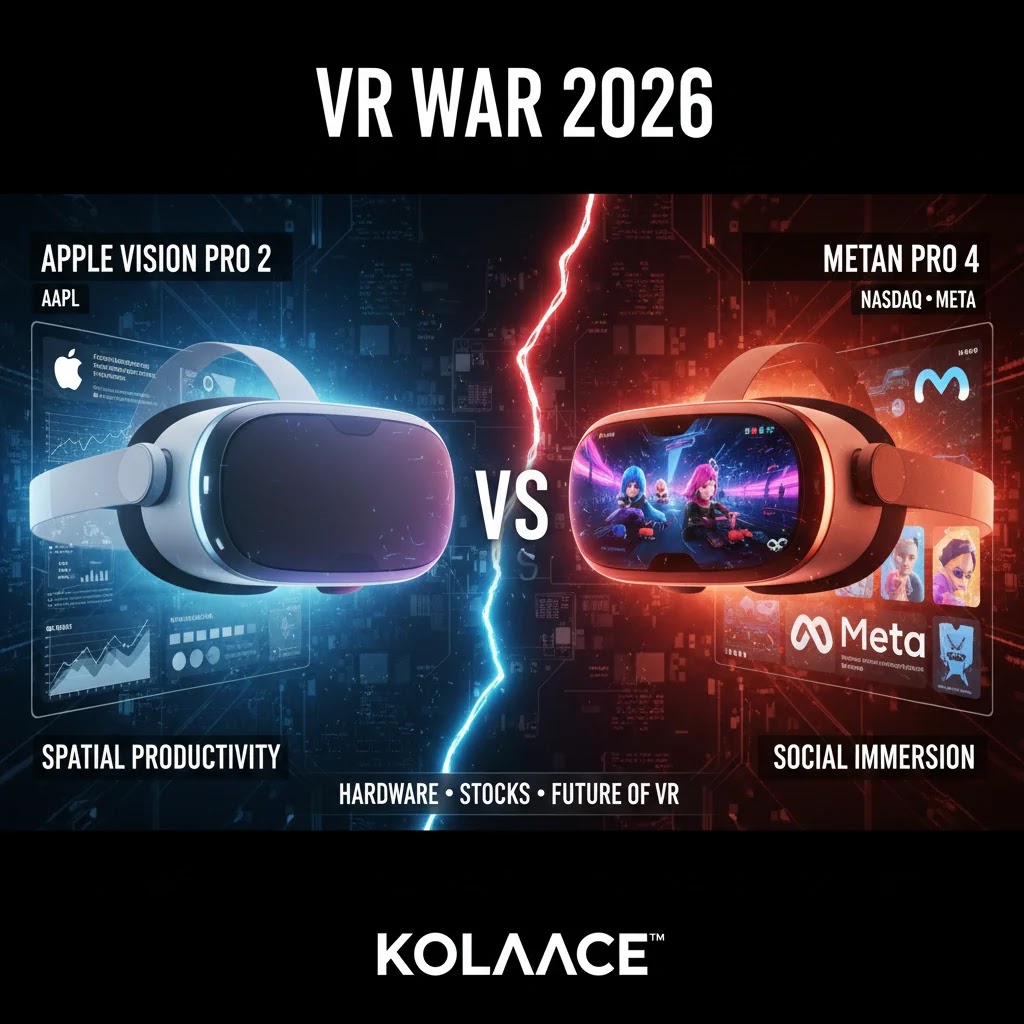
By 2026, the VR and AR space has clearly split into two levels. On one side stands the Apple Vision Pro 2, a premium device powered by the M5 chip. On the other side is the Meta Quest 4, built for affordability and social experiences. For KOLAACE™ investors, the real question is not only which headset performs better, but which company’s stock gains more from the rise of spatial computing.
1. Hardware Breakdown: M5 Power vs. Snapdragon XR3
The Apple Vision Pro 2 has improved on its earlier version by reducing weight and boosting performance significantly. It feels more practical for long work sessions. In contrast, the Quest 4 focuses on bringing mixed reality to everyday users, using advanced Qualcomm chips to deliver sharp visuals at a much lower price.
- Apple Vision Pro 2: Comes with Micro-OLED displays and a 120Hz refresh rate, powered by M5 Silicon. It works like a full workstation, almost replacing a laptop. For example, designers or video editors can work on large virtual screens without needing physical monitors.
- Meta Quest 4: Uses pancake lenses and upgraded haptic controllers. It is designed mainly for social gaming hubs and fitness. In India, many users already use it for home workouts instead of going to crowded gyms.
Market Share: VR/AR Unit Shipments (2026 Projection)
Source: IDC Tracker 2026. Meta leads in shipment volume, while Apple earns higher revenue per device and benefits from strong ecosystem control.
2. Comparison: Specs & Investment Potential
When looking at these as metaverse stocks, the focus shifts to margins and scale. Apple earns more per user, while Meta focuses on reaching a larger audience.
| Feature | Apple Vision Pro 2 | Meta Quest 4 |
|---|---|---|
| Processor | Apple M5 Silicon | Snapdragon XR3 |
| Optics | Micro-OLED (5K) | LCD Pancake (4K) |
| Stock Upside | Steady ecosystem-driven growth | Fast growth driven by social ads and user expansion |
KOLAACE™ Tech Report
3. The Software Edge: visionOS vs. Horizon OS
Hardware alone does not decide the winner. Apple’s visionOS 2.6 works smoothly with v-commerce, letting users shop just by looking and selecting items. On the other hand, Meta has opened its Horizon OS to brands like Asus and Lenovo, similar to how Android expanded in smartphones.