The year 2026 has officially marked the end of “Traditional Rendering.” With the release of NVIDIA DLSS 4.5 and AMD FSR 4.0 (Codename: Redstone), the industry has fully pivoted toward AI-generated pixels. We are no longer asking if a GPU can run a game at native 4K; we are asking how many “AI Frames” it can generate without losing visual fidelity.
In this KOLAACE™ deep dive, we compare the two titans of upscaling to see which one deserves a spot in your 2027 build.
I. DLSS 4.5: The Rise of the 2nd Gen Transformer
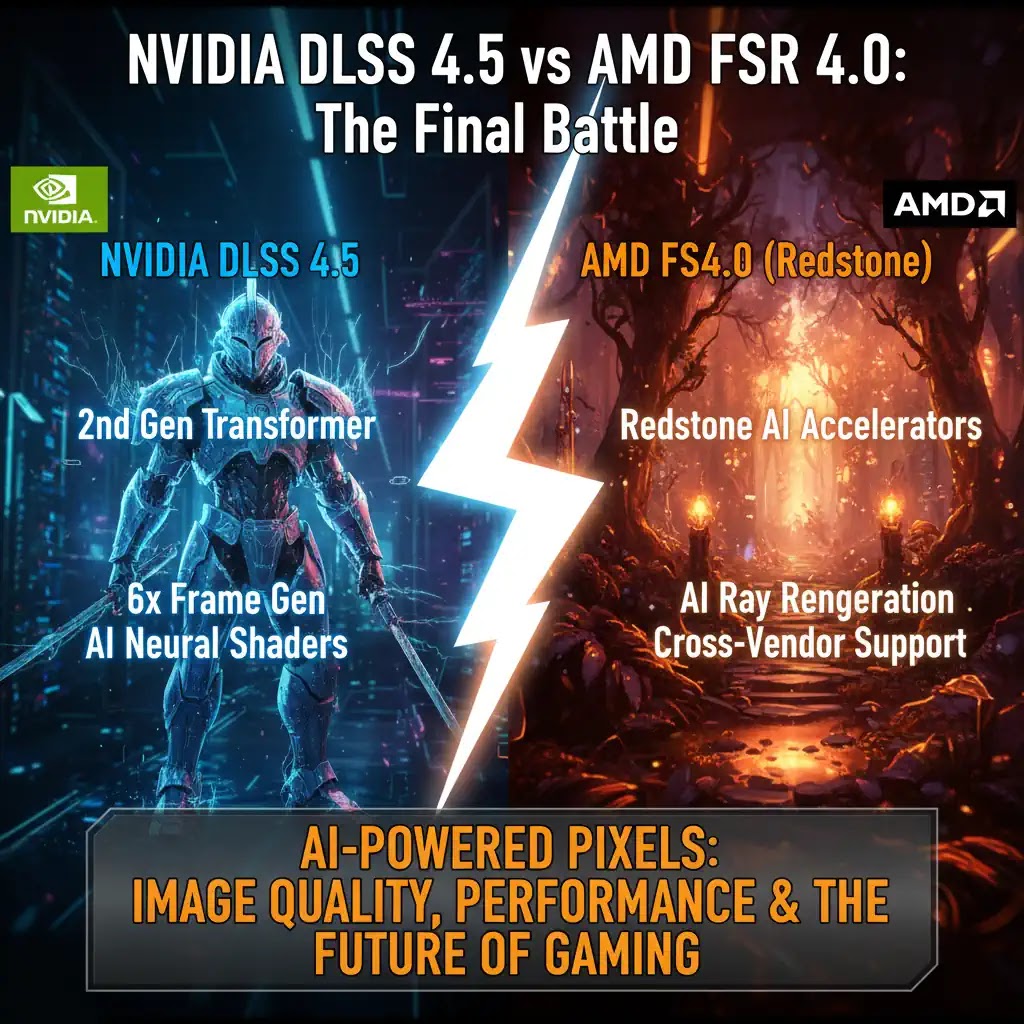
NVIDIA’s DLSS 4.5 is a refinement of the groundbreaking Transformer-based architecture introduced with the RTX 50-series (Blackwell). Unlike previous versions that used Convolutional Neural Networks (CNN), version 4.5 utilizes a 2nd Generation Transformer model trained on 5x more compute data.
Key Innovations in DLSS 4.5:
- Dynamic Multi-Frame Generation: Automatically scales from 1x to 6x frame generation based on real-time motion complexity to maintain a 240Hz target.
- RTX Neural Shaders: Replaces traditional texture filtering with AI-driven reconstruction, virtually eliminating “shimmer” on thin geometry.
- Ultra-Performance 4K: For the first time, DLSS Performance mode is indistinguishable from Native 4K in side-by-side blind tests.
II. FSR 4.0 Redstone: AMD Goes Full AI
AMD has finally abandoned the spatial-temporal analytical approach of FSR 3.1. FSR 4.0 Redstone is AMD’s first fully AI-powered suite, leveraging the specialized AI Accelerators in the RDNA 4 (RX 9000) series. While it remains more compatible than DLSS, its “best” mode is now locked behind modern hardware to ensure enough TOPS for the AI model.
Key Innovations in FSR 4.0:
- AI Ray Regeneration: AMD’s answer to Ray Reconstruction, specifically designed to clean up noisy ray-traced reflections on RX 9000 cards.
- FidelityFX Frame Boost: A hardware-accelerated frame interpolation method that significantly reduces the “warping” artifacts seen in FSR 3.
- Open-Source INT8 Path: A legacy mode that allows older GPUs (RX 6000/7000) to use FSR 4.0 with reduced precision.
| Feature | NVIDIA DLSS 4.5 | AMD FSR 4.0 |
|---|---|---|
| AI Model Type | 2nd Gen Transformer | CNN (Convolutional) |
| Max Frame Gen | 6x (Exclusive to RTX 50) | 3x (FidelityFX Boost) |
| Compatibility | RTX Only (Best on Blackwell) | Cross-Vendor (Open Source) |
| Ghosting/Artifacts | Near Zero (Neural Shading) | Minimal (Significant jump from FSR 3) |
III. Market Adoption: The Software-First Shift
In 2026, NVIDIA and AMD are no longer competing just on silicon; they are competing on Software Support. NVIDIA’s Streamline plugin has made DLSS 4.5 integration almost “one-click” for developers, resulting in a library of over 450 supported titles by mid-2026.
Market Growth: AI Upscaling Integration (Total Game Support)
NVIDIA maintains a lead in raw title count, but AMD’s open-source nature is winning in the indie and modding communities.
— KOLAACE™ Engineering
Final Verdict
If you demand the absolute best image quality at 4K and 8K, NVIDIA DLSS 4.5 remains the king due to its more advanced Transformer-based training. However, AMD FSR 4.0 has closed the gap significantly, making high-end AI upscaling accessible to budget gamers and handheld users (Steam Deck 2/Asus Ally 2026).