By the time we hit the holiday season of 2027, the silicon inside your gaming rig will have undergone its most significant transformation since the invention of the transistor. The leap from TSMC’s 3nm (N3) node to the 2nm (N2) era isn’t just about making things smaller—it’s about changing the physics of electricity inside your GPU.
In this KOLAACE™ guide, we analyze the technical warfare between 3nm and 2nm and how this “Node Shrink” will define the performance of the NVIDIA RTX 60-series and AMD Zen 6 processors.
1. The 3nm Plateau: FinFET’s Last Stand
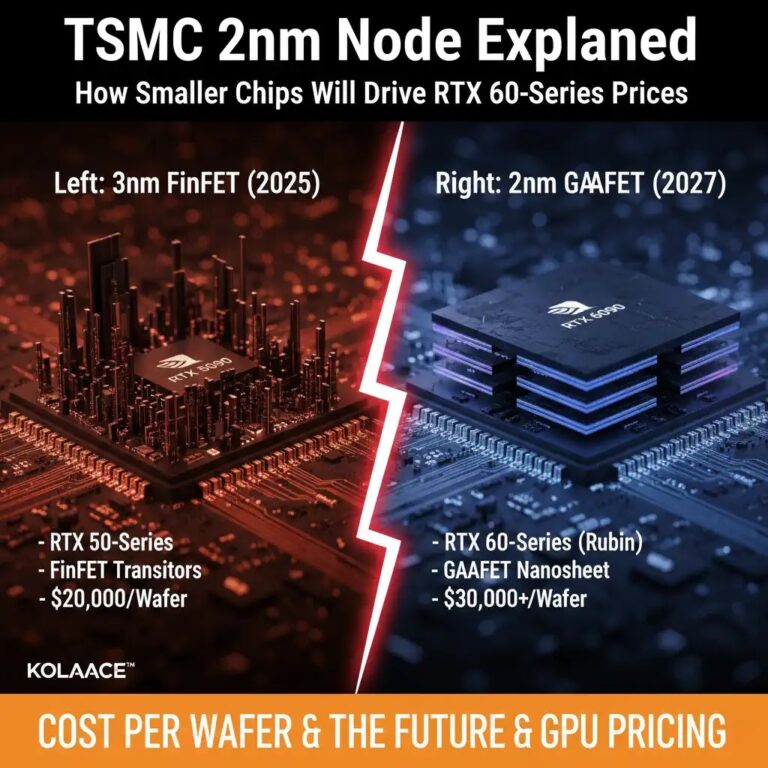
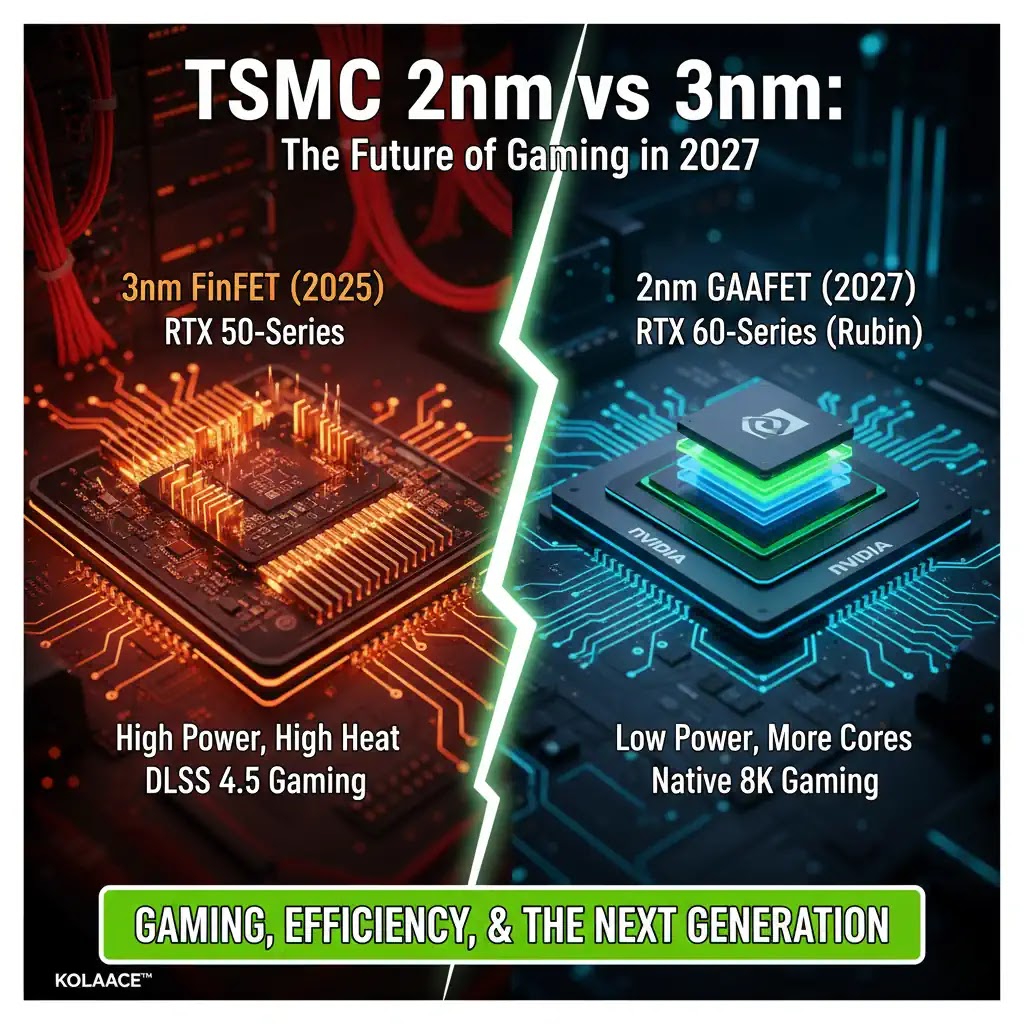
Current 2025/2026 hardware, like the RTX 50-series (Blackwell), relies on 3nm technology. While 3nm offered a solid density boost over 5nm, it still uses FinFET (Fin Field-Effect Transistor) architecture. At 3nm, we have officially hit the “leakage wall,” where electricity begins to jump the fins even when the transistor is turned off, leading to heat and wasted power.
The 3nm Era Gaming Profile: High performance, but requires massive cooling (450W+ TDPs) to maintain stability at high clock speeds.
2. The 2nm Revolution: The Magic of GAAFET
TSMC’s 2nm node, entering its “Golden Year” in 2027, ditches FinFET for GAAFET (Gate-All-Around). In this design, the gate surrounds the channel on all four sides. This provides 100% control over the current, allowing for much lower operating voltages.
- Performance Jump: A 10-15% speed increase over 3nm at the same power levels.
- Power Efficiency: A staggering 25-30% reduction in power consumption.
- Density: Up to 20% higher transistor density for pure logic designs (more CUDA cores!).
Market Growth: 2nm vs 3nm Performance Scaling
By late 2027, N2P (featuring backside power delivery) will provide the final performance peak of the 2nm era.
3. Impact on Hardware: RTX 60 & Zen 6
What does this mean for your future build? In 2027, the RTX 6090 (Rubin) is expected to be the first consumer GPU to leverage 2nm. With the increased density, NVIDIA can fit significantly more RT (Ray Tracing) and Tensor cores without increasing the size of the chip.
| Metric | 3nm (2025/26) | 2nm (2027) |
|---|---|---|
| Transistor Type | FinFET | GAAFET Nanosheet |
| 8K Gaming Viability | With DLSS 4.5 | Native / Low Upscale |
| Average GPU TDP | 400W – 500W | 300W – 400W |
— KOLAACE™ Engineering
Final Verdict
If you are planning an upgrade in early 2026, the 3nm RTX 50-series will be a powerhouse. However, if you want the first “Efficient Era” PC—one that delivers double the performance of an RTX 4090 at lower power—you should wait for the 2nm Rubin cards in 2027. The shift from FinFET to GAAFET is the biggest win for PC gamers this decade.