
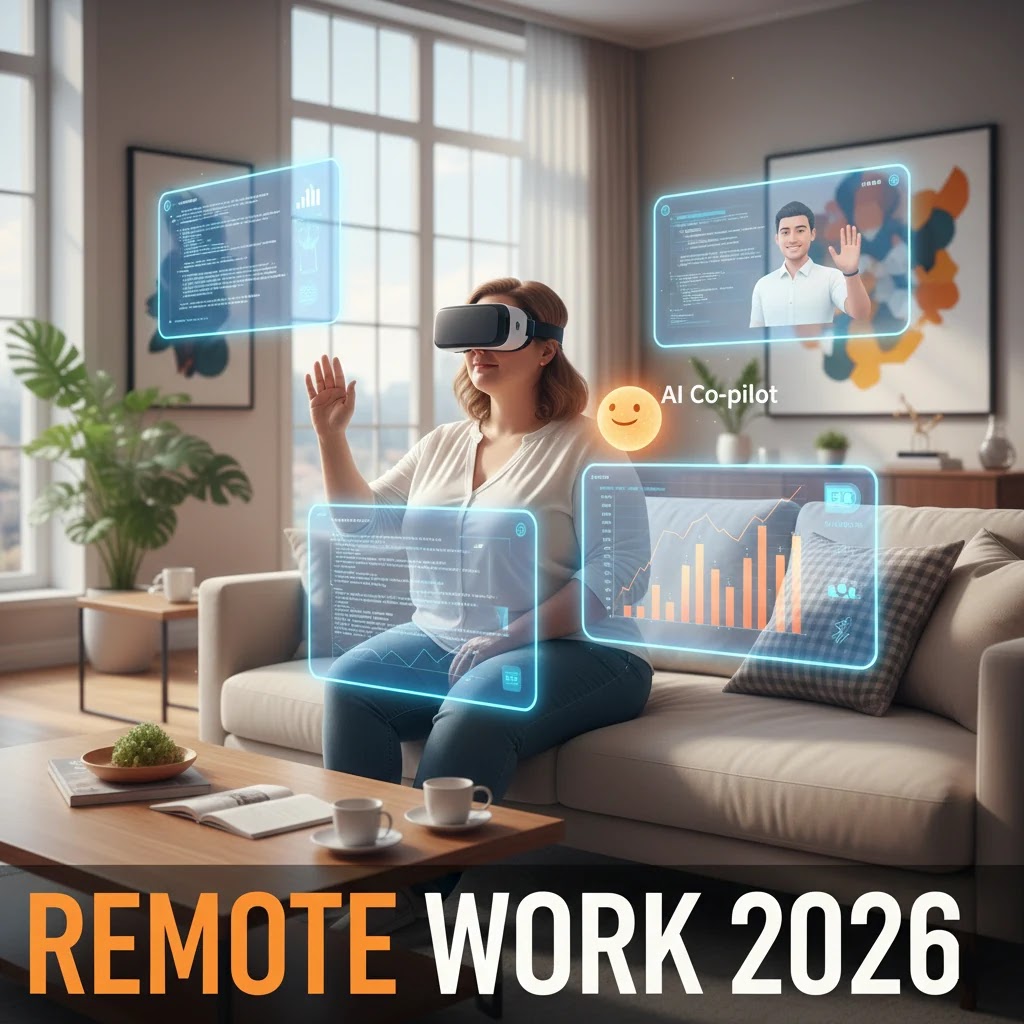
By February 2026, the “Zoom Fatigue” of the early 20s is a distant memory. We have entered the era of Presence Equity. Whether you are working from a beach in Bali or a skyscraper in New York, the use of Spatial Computing ensures that every team member feels physically present in a shared, immersive environment.
At KOLAACE™, we view remote work not just as a location change, but as a cognitive upgrade. With the integration of AI Co-pilots that manage our schedules, summarize our meetings, and even draft our code, the modern worker has become a high-level orchestrator of autonomous systems.
I. From 2D Screens to Spatial Productivity
The “Flat Web” is dead. In 2026, remote workers use Mixed Reality (MR) headsets to overlay their digital tools onto their physical environment. This “Infinite Canvas” allows for multi-tasking capabilities that were physically impossible on traditional monitors.
Remote Work Efficiency: VR vs. Traditional (2026 Data)
*Efficiency measured by deep-work hours and collaborative output.*
II. AI Co-pilots: Your Autonomous Chief of Staff
In 2026, you don’t work “with” AI; the AI works “for” you. Personalized Co-pilots now handle the administrative heavy lifting that used to consume 60% of a remote worker’s day.
| Tool Category | 2026 Standard | Impact on Output |
|---|---|---|
| Meeting Agents | Autonomous Avatars | Agents attend low-priority meetings and sync back key decisions. |
| Workflow Sync | Predictive Tasking | Systems predict your next move and prep files/data in advance. |
| Deep Work Guard | Biometric Bio-feedback | AI blocks distractions based on your real-time focus levels. |
III. The Rise of the “Sovereign Worker”
The traditional 9-to-5 employment contract is dissolving. In 2026, top talent operates as Sovereign Entities—leveraging their own AI stacks to provide massive value to multiple organizations simultaneously.
- Micro-Consulting: Instead of full-time roles, workers provide “Expert Sprints” aided by their own proprietary AI models.
- The Bio-Optimized Schedule: As mentioned in our Biohacking Report, work hours are now set by circadian rhythms, not time zones.
- VR Team Building: Remote culture is built in “Digital Third Places”—hyper-realistic VR environments where teams bond through shared experiences that mimic physical proximity.
IV. Essential Tech for the 2026 Remote Leader
- Haptic Feedback Wearables: To feel a handshake or a “tap on the shoulder” in the VR office, adding a layer of human connection back to digital work.
- Neural-Linked Focus Tools: Non-invasive EEG headbands that help your AI Co-pilot understand when you are in a “flow state” to prevent interruptions.
- Post-Quantum VPNs: As we discussed in our Cybersecurity Guide, protecting your remote connection from quantum threats is the new security baseline.
Ready to upgrade your home setup for the Metaverse? Check out our Hardware Forecast or optimize your internal ‘operating system’ with our Biohacking News.