Urban congestion is no longer a future concern. In 2026, it is an everyday reality for millions of people living in fast growing cities. Housing shortages, rising land prices, traffic congestion, polluted air, and limited green space are forcing governments and architects to rethink how cities are designed. Instead of expanding outward into forests and farmland, urban planners are now building upward with a stronger focus on sustainability, smart infrastructure, and resource efficiency.
The concept of the Vertical City has evolved from a futuristic architectural experiment into a practical urban development strategy. As discussed in our report on 6G-connected smart hubs, next generation cities are becoming digitally connected ecosystems where transportation, food production, security, energy systems, and residential spaces operate within the same structure.
What makes this shift important is that vertical cities are not only designed for wealthy nations. Urban researchers are actively studying how these models can reduce pressure in densely populated regions across Asia, including India, where land availability and infrastructure strain continue to increase each year.
1. What Is a Vertical City and Why Is It Growing So Fast?
A vertical city is a high density urban system where multiple essential services are stacked within interconnected towers or mega structures. Instead of separating homes, offices, schools, hospitals, farms, and shopping areas across long distances, these functions are combined inside a connected vertical environment.
In practical terms, residents may live on one floor, work ten floors above, buy groceries grown inside the building, and access healthcare within the same complex. This reduces travel time, lowers fuel consumption, and improves overall land efficiency.
Key Features of Vertical Cities in 2026
- AI managed energy optimization systems
- Integrated vertical farming zones
- Smart waste recycling infrastructure
- Autonomous elevator transportation networks
- Water recycling and rain harvesting systems
- Biometric security and digital access management
- 6G and edge computing enabled communication layers
One important observation from current urban pilot projects is that mixed use integration significantly improves efficiency. In older cities, residents may spend two to four hours daily commuting. In vertical city systems, this can be reduced dramatically because essential services are concentrated in one structure.
2. The Saudi “Line” Pivot and the Shift Toward Practical Urbanism
One of the most discussed developments in 2026 is the redesign of Saudi Arabia’s The Line project. Initially presented as a 170 kilometer mirrored megacity, the project has gradually shifted toward more realistic and modular development zones.
The focus is now moving toward high density districts that prioritize data centers, climate controlled infrastructure, energy efficiency, and AI powered urban management. This pivot is important because it highlights a major lesson in modern urban planning. Large futuristic projects must eventually balance ambition with operational sustainability.
Urban analysts believe this transition reflects a broader industry trend. Governments are becoming more cautious about extremely expensive mega projects and are instead prioritizing scalable vertical infrastructure that can adapt over time.
What Urban Developers Learned from Early Vertical City Projects
- Cooling systems consume massive amounts of energy in dense environments
- Transport inside tall structures requires intelligent traffic coordination
- Digital infrastructure is now as important as roads and pipelines
- Residents demand access to green spaces, not only apartments
- Emergency response systems must work across multiple vertical layers
These insights are influencing new projects across Asia and Europe. Instead of building isolated skyscrapers, developers are designing interconnected urban ecosystems with shared utilities and centralized AI management.
Many experts compare this phase to the early growth of smart factories. Initially, automation looked expensive and experimental. Over time, it became commercially practical as systems improved and operational costs decreased.
3. Vertical Forests and Climate Friendly Urban Design
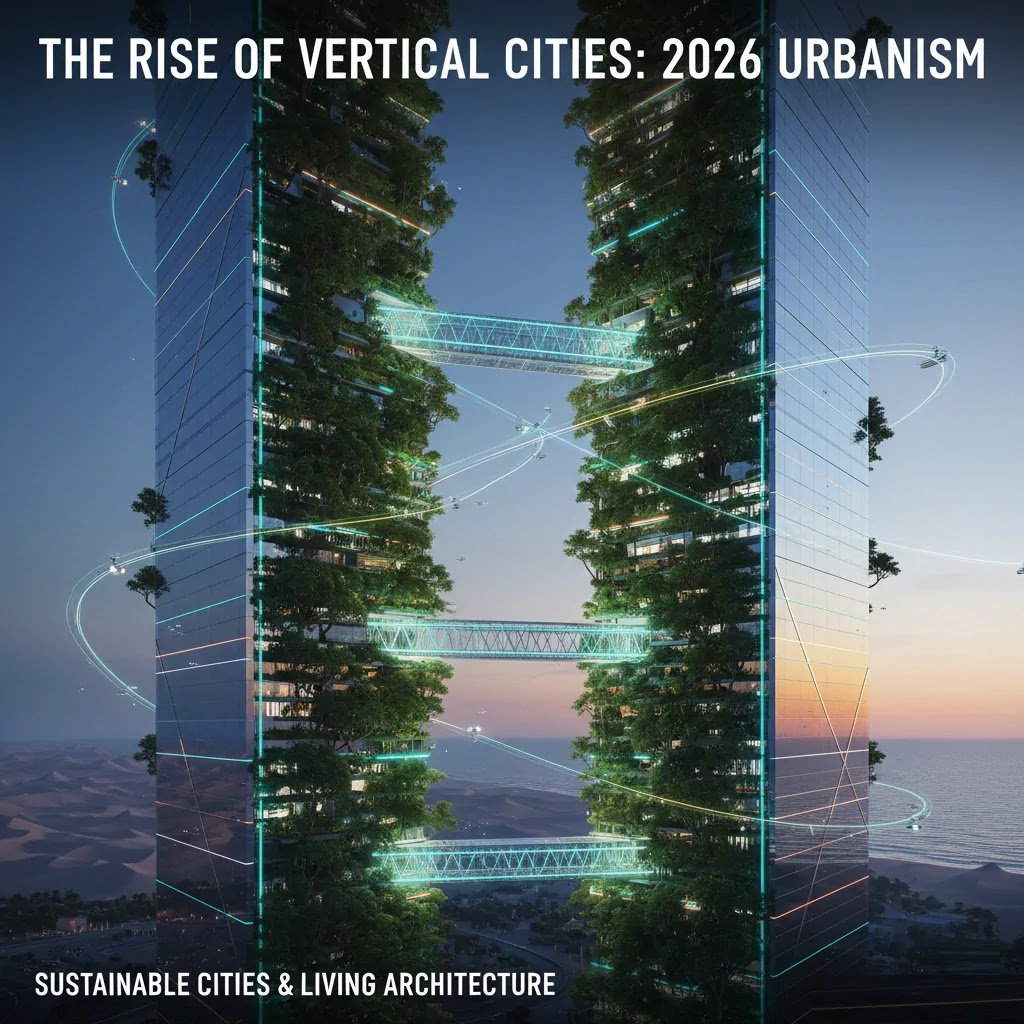
One of the biggest criticisms of high density cities has always been the lack of greenery and poor air quality. That challenge is now being addressed through vertical forests and living architecture systems.
Projects like the Wonderwoods Vertical Forest in Utrecht are demonstrating how buildings can function as environmental infrastructure instead of concrete heat traps. These towers integrate thousands of plants directly into balconies, terraces, and structural layers.
The results are becoming measurable:
- Lower heat retention around buildings
- Improved air filtration
- Better insulation efficiency
- Reduced urban noise pollution
- Higher resident satisfaction and mental wellness
This approach has gained attention in countries facing extreme urban heat conditions. Indian metro cities, where temperatures regularly rise due to concrete density and traffic emissions, may benefit significantly from similar hybrid green infrastructure models.
Urban Models: Vertical City vs. Traditional Sprawl (2026 Data)
| Feature | Traditional City | Vertical City (2026) |
|---|---|---|
| Land Use Efficiency | Low, Urban Sprawl | Ultra High Density Usage |
| Security Protocol | Manual Monitoring | Biometric heartbeat verified systems |
| Access to Nature | Separate Parks | Integrated Green Architecture |
| Travel Time | High Daily Commute | Localized Movement |
4. Hyper Local Food Systems and Vertical Farming
Food security is becoming a major part of urban planning in 2026. Modern vertical cities are not only designed for housing people. They are increasingly designed to feed them as well.
The vertical farming industry has crossed the multi billion dollar stage because urban developers now see agriculture as critical infrastructure. Instead of transporting vegetables hundreds of kilometers, produce can be grown directly inside residential or commercial towers.
These farms use controlled LED lighting, automated irrigation systems, AI nutrient monitoring, and edge computing infrastructure to optimize crop growth with minimal waste.
Why Vertical Farming Matters in Dense Cities
- Reduces food transportation costs
- Improves freshness and shelf life
- Uses less water compared to traditional farming
- Supports local food resilience during supply disruptions
- Creates employment in urban agriculture technology
Several startups are already testing apartment integrated hydroponic systems where residents can grow vegetables within shared community farming floors. For smaller businesses, this creates new opportunities in food logistics, maintenance services, AI monitoring systems, and sustainable construction.
5. Advantages and Challenges of Vertical Cities
Major Advantages
- Efficient use of limited land resources
- Reduced traffic congestion and pollution
- Integrated energy and water management
- Improved disaster response coordination
- Lower infrastructure expansion costs over time
- Faster digital connectivity through centralized systems
Important Challenges
- Extremely high construction costs
- Complex maintenance requirements
- Cybersecurity risks in AI controlled infrastructure
- Dependence on uninterrupted power systems
- Potential social isolation if poorly designed
- Need for strong emergency evacuation planning
From an infrastructure perspective, one of the biggest concerns is digital dependency. As cities become more connected, failures in network systems or AI coordination platforms could disrupt elevators, water systems, and traffic management simultaneously.
This is why urban cybersecurity is becoming just as important as physical construction quality.
6. Who Benefits Most from Vertical Cities?
Vertical cities are not intended to replace every type of urban area. Their effectiveness depends heavily on population density, economic activity, and infrastructure readiness.
Best Fit Scenarios
- Highly populated metro regions
- Land constrained coastal cities
- Technology driven business districts
- Regions facing severe housing shortages
- Smart city development programs
Less Suitable Scenarios
- Low population rural regions
- Areas with unstable electricity infrastructure
- Regions with limited digital connectivity
- Economies unable to support long term maintenance
For developing economies, hybrid adoption may become the most realistic approach. Instead of building entire vertical cities immediately, governments may gradually integrate smart transport, vertical farming, and mixed use tower systems into existing urban layouts.
7. A Rapidly Expanding Vertical Urbanism Market
Investment in vertical urban infrastructure continues to rise as governments search for scalable solutions to housing pressure and environmental sustainability. Smart construction systems, AI controlled utilities, and modular building technologies are accelerating adoption.
Global Vertical Urbanism Market ($ Billions)
One interesting trend is that technology companies are now participating directly in urban infrastructure projects. Cloud computing firms, AI developers, energy management startups, and robotics companies are increasingly becoming part of real estate development partnerships.
This shows that the cities of 2026 are no longer viewed only as construction projects. They are becoming large scale digital operating systems.
8. Best Practices for Future Vertical City Development
- Prioritize human comfort, not only density targets
- Integrate green spaces into every development layer
- Build decentralized energy backup systems
- Use AI carefully with strong cybersecurity protections
- Create mixed income housing to avoid social segregation
- Develop strong public transport connectivity around towers
- Design modular systems that can evolve over decades
Urban experts consistently warn against treating vertical cities purely as luxury projects. The most successful models focus on long term livability, affordability, and infrastructure resilience.
KOLAACE™ Verdict
Vertical cities are emerging as one of the strongest responses to overpopulation, land scarcity, and climate pressure in 2026. The concept is no longer limited to futuristic design presentations. It is becoming a practical urban strategy supported by AI systems, sustainable architecture, vertical farming, and integrated digital infrastructure.
The next phase of urban growth will likely combine smart technology with environmentally conscious design. Cities that successfully balance efficiency, sustainability, and human comfort may become the global benchmark for future development.
To explore more future focused infrastructure trends, read our coverage of Physical AI systems and the latest developments in AI technology.
9. Frequently Asked Questions
Are vertical cities environmentally sustainable?
They can be significantly more sustainable than traditional urban sprawl if they integrate renewable energy, water recycling, green architecture, and efficient transportation systems.
Will vertical cities replace traditional cities completely?
No. Most experts expect hybrid urban development where existing cities gradually adopt vertical infrastructure rather than complete replacement.
How do vertical cities reduce traffic problems?
By placing homes, workplaces, services, and entertainment within the same structure, residents travel shorter distances daily.
What technologies power vertical cities in 2026?
Artificial intelligence, edge computing, biometric security, smart energy grids, autonomous transport systems, and vertical farming technologies are among the key systems.
Can developing countries adopt vertical city models?
Yes, but gradual implementation is more realistic. Many cities may first adopt smart infrastructure, mixed use towers, and vertical farming before developing fully integrated vertical ecosystems.